Do Cartoons Really Help My Child Learn English? A Guide by Age
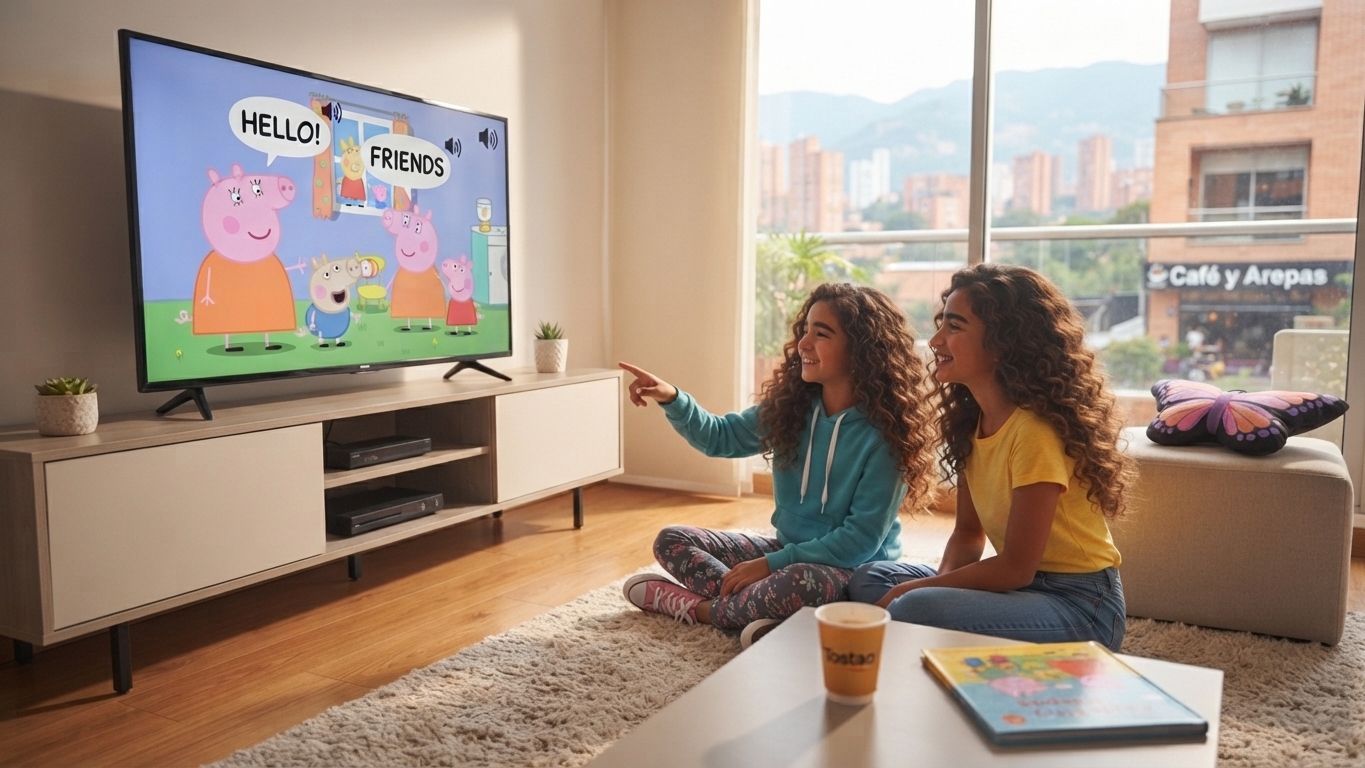
It's a question you've probably asked yourself in front of the tablet: "do I let them watch this in English, or is it just screen time?" The short answer is yes, it helps — but only if you know what to look for at each age, and only if you understand the part of learning a screen can never do for you.
For the youngest ones (ages 3–7): making English feel familiar
At this age it's not about understanding every word — it's about the sound of English becoming something everyday and pleasant. Look for shows with simple dialogue and lots of repetition: Peppa Pig (short sentences, a "small problem → happy ending" pattern), Bluey (a bit more story and visual context) and Cocomelon (everything set to song, great for vocabulary that sticks at two or three years old).
A trick many parents in our channel use: watch it in Spanish first. Once your child already knows the story and characters, switch to English — they no longer have to follow the plot and the language at the same time.
Ages 7–10: ready for a longer story
Vocabulary grows here and dialogue gets more natural: SpongeBob SquarePants (lots of character dialogue, good for picking up set phrases), Thomas & Friends (very clear story structure) and Bob the Builder (problem-solving vocabulary that repeats episode after episode).
Ages 10 and up: real dialogue, humor, cultural references
At this age kids can handle irony and idiomatic expressions: Gravity Falls, Scooby-Doo and Kim Possible, with fast, natural dialogue close to how real teenagers actually talk.
What no cartoon can do
A show teaches vocabulary through repetition — and that has real value. But it's learning that happens without you: there's no page the two of you can point to together, no question you can answer together.
That's why at VertaClassics we don't see cartoons as competition for bilingual reading — we see them as a complement. A mirror-text book, like the ones in our Maya & Mateo collection, does what a screen can't: it sits you next to your child, in a language you can follow too, with a story told twice — in Spanish and in English — and a refrain they end up saying together, by heart, long after the last page.
Cartoons give your child the ear. A bilingual story, read aloud, gives them the conversation.
Keep exploring