British or American English? The Question Every Parent Asks (and the Answer Nobody Expects)

One day your child comes home from school and says they're going to play football. You, raised on American movies, picture helmets, shoulder pads and an oval ball. They mean soccer, the game the rest of the world calls football.
Welcome to the little puzzle of having two kinds of English on one planet.
First, the words
UK lift · US elevator
UK flat · US apartment
UK lorry · US truck
UK biscuit · US cookie
UK trousers · US pants
UK rubbish · US trash
UK holiday · US vacation
UK queue · US line
And a classic trap: in British English, pants means underwear. One little difference, one family anecdote for life.
Second, the spelling
There are patterns here, not just scattered exceptions, and that helps children:
• colour, favourite, neighbour (UK) → color, favorite, neighbor (US)
• centre, theatre (UK) → center, theater (US)
• organise, realise (UK) → organize, realize (US)
• travelling, cancelled (UK) → traveling, canceled (US)
Once a child sees a rule rather than a mistake, they stop feeling as if they are spelling everything wrong.
Third, the sound
In many British accents, the r at the end of car is barely heard; in most American accents, you hear it. The vowel in bath or can't changes across the Atlantic too.
This matters less than you might think. Children understand both accents long before they settle into one themselves, just as a child in Colombia understands an uncle from the coffee region and a grandmother from the coast without getting confused.
And a little grammar
Britons say I've got a brother; Americans often say I have a brother. The past participle of get is got in the UK and gotten in the US. Dates differ too: 09/07 means September 7 in the United States and July 9 in the UK. That one is worth teaching: it can prevent confusion on forms and tickets.
Now, what really matters to us
In Latin America, the English that comes through the door is mostly American: YouTube, Netflix, music, video games, cousins in Miami and remote work. Yet many bilingual schools in the region use British curricula and prepare students for Cambridge exams.
The result: our children are already learning a mix. And that's okay.
1. Don't correct the mix. If your child says lift one day and elevator the next, they're not confused: they know two words for the same thing, like someone who knows both "tinto" and "café".
2. Ask for consistency only in writing. In one piece of writing, stick with either colour or color. Many international exams accept both varieties, but consistency within one answer matters.
3. If the school follows one curriculum, follow it at home too. Not for the sake of purity, but so your child doesn't feel you're correcting the teacher.
The conclusion nobody likes at first
There is no single "correct" English. What matters is the English your child understands and the English they can use to make themselves understood. A child who watches American shows, reads a British book and writes to a cousin in Houston doesn't have a method problem: they have exposure, which is exactly what they need.
Fifteen minutes of reading aloud are worth more than any debate between London and New York.
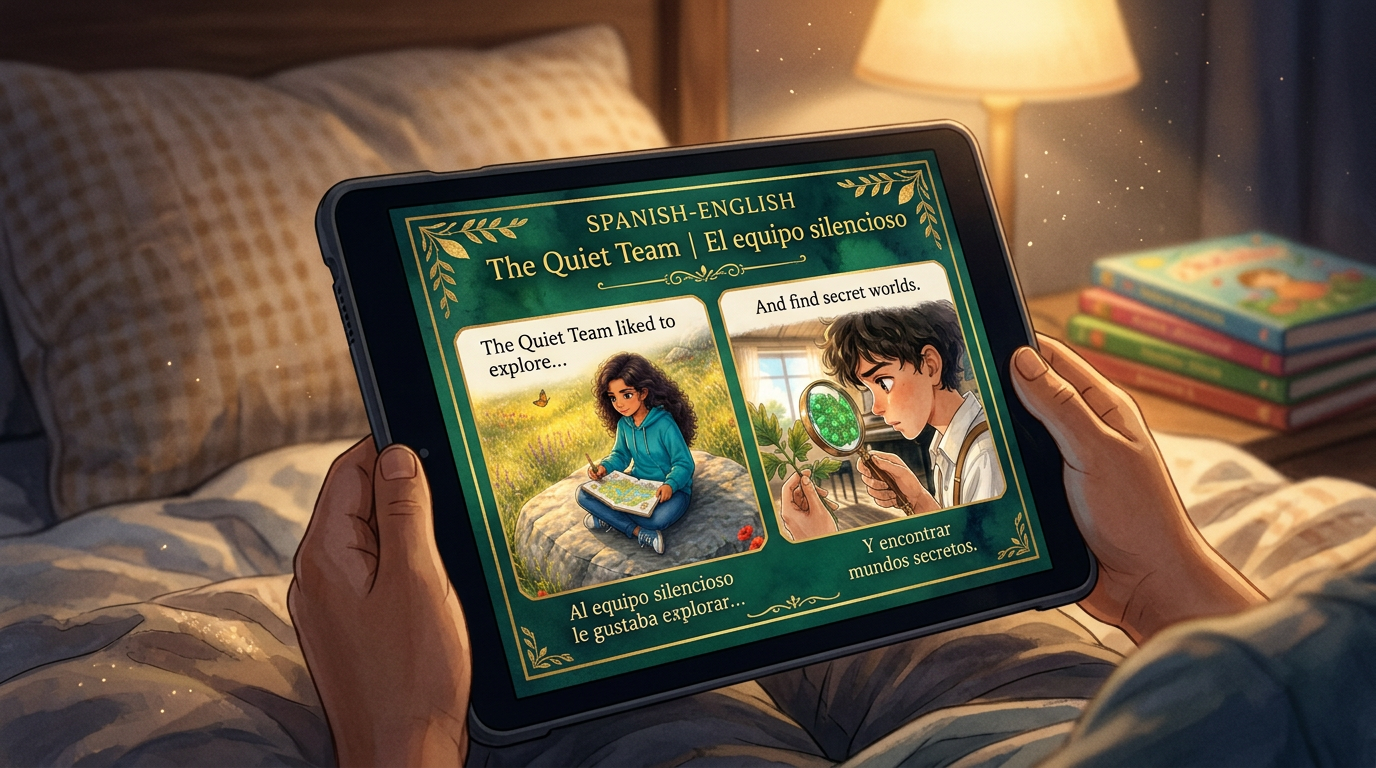
And if you read both languages on the same page, all the better: children make comparisons on their own, without anyone testing them.
Explore the bilingual stories of Maya & Mateo.
Keep exploring